

Some individuals are just born givers. They spend their lives nourishing everyone around them without asking for much in return. You’re probably picturing someone you know and love right now; perhaps a parent, a friend, or a sibling. We’re thinking about coconut trees.
In Indonesia’s food forests, coconut trees play a vital role. They draw water and nutrients from deep within the earth, taking only what they need while helping to support the diverse ecosystem around them. Beneath their canopy, fruits like durian, bananas, coffee, and cacao flourish together in harmony. Idyllic, right?
With its lush forests and extraordinary biodiversity, it’s no surprise that so many travelers fall in love with Indonesia. When Benjamin Ripple landed in Bali with his new girlfriend, Blair, nearly 30 years ago, he planned to do what most backpackers do: swim in the ocean, soak up the culture, eat incredible food, and eventually move on. Three decades later, he’s still there. He’s now married to Blair, and these days, they’re doing a little more than sightseeing. They’re the founders of Big Tree Farms, a coconut sugar and coconut aminos brand, and the largest vertically integrated supply chain for coconut flower nectar in the world.
Coconut trees, with their incredible versatility and place within Indonesia’s food forests, captured Ripple’s imagination. More specifically, it was the tree’s nectar—known locally as nira—that changed everything. Today, it forms the basis of every Big Tree Farms product, from coconut sugar and coconut aminos (a lower-sodium, soy-free alternative to soy sauce) to umami-rich marinades and the brand’s popular vegan Indonesian BBQ range.
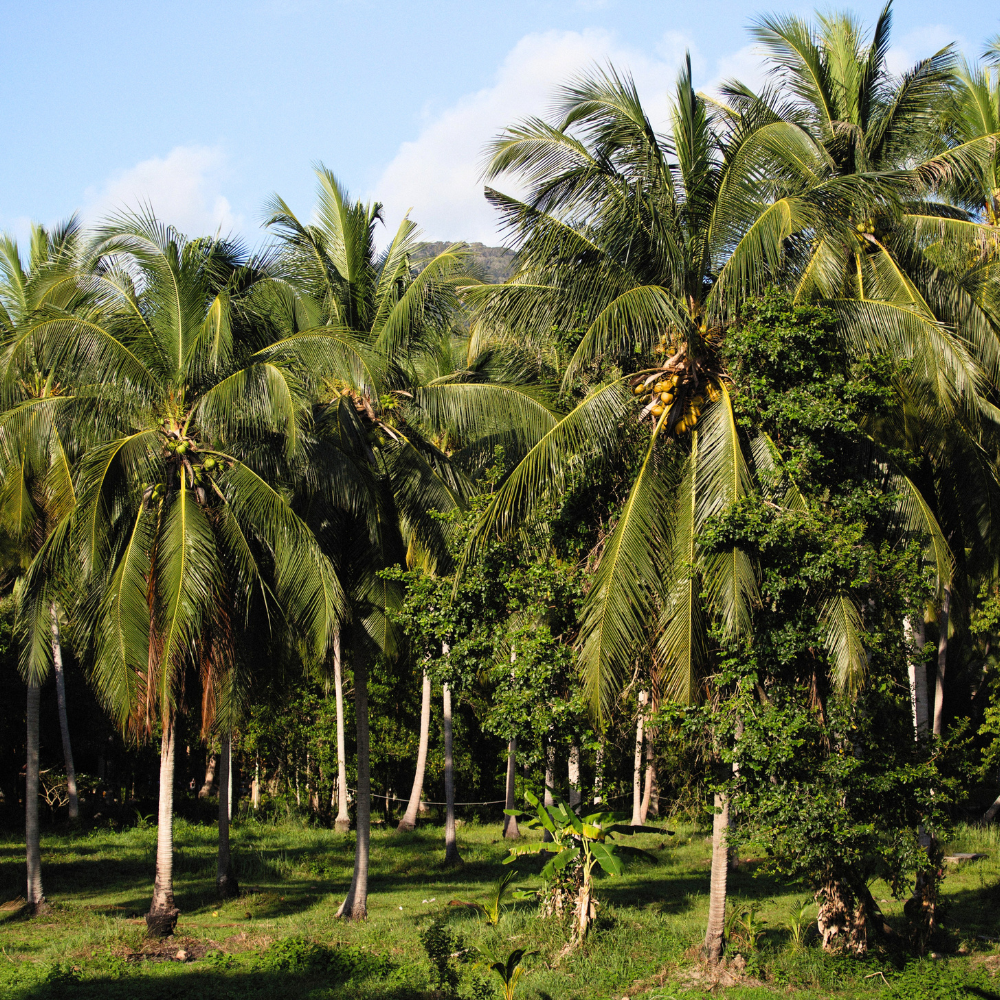 Coconut nectar, or nira, has been harvested from coconut palms across Indonesia for generations. | Canva
How one Indonesian ingredient inspired Big Tree Farms
Nira has been harvested across Indonesia for centuries, but it remains relatively unknown outside the country. That’s why, when Ripple first came across a block of coconut sugar in a Balinese market, he was instantly captivated. “I took a bite, and I was just blown away,” he told VegNews. “It didn’t taste like sugar. It tasted like butter and caramel. It was the most amazing flavor.”
Determined to learn more, he did what any curious traveler would do: he followed his nose. “I hunted down this village called Dawan in East Bali,” he recalls. “And while I was just walking the streets, I was using my nose to find the sugar, and I found it.” There, he met a coconut farmer named Papanku, who introduced him to the centuries-old practice of harvesting nira.
It’s no easy task. Every day, tens of thousands of farmers across Indonesia climb coconut palms that can reach up to 32 yards tall. High in the canopy, they carefully tap the flower blossoms to collect the naturally sweet nectar, which is then transformed into palm wine or slowly cooked down into coconut sugar.
Inspired, Ripple—who, at the time, wanted to source more unique ingredients for the supper club he was running on Blair’s organic farm—followed his nose again. This time, to the mountains of Jakarta in Java.
“I was driving around on a motorbike, and I smelled that smell. Caramel,” he says. Ripple walked through a food forest, and there, living in a small cottage next to the farm, was a man named Sugio, who had his own technique for processing nira. Instead of leaving it in the block, he would use the coconut shell to rub against the nectar, breaking it into granules, so it looked just like regular sugarcane.
The penny dropped for Ripple. Sugio was a pioneer. “He was the original Johnny Appleseed of granulated coconut sugar,” said Ripple. “His name just happened to be Sugio. So, we called him Shugi.”
Ripple and Sugio worked together to train more farmers, fine-tune the harvesting process to improve efficiency, and expand the network. By 2003, six years after Ripple and Blair arrived in Indonesia for a fun backpacking trip, Big Tree Farms was born.
Today, more than two decades later, the company works with more than 21,000 producers across Indonesia, bringing nira-derived products to consumers through retailers including Whole Foods Market, Sprouts, Erewhon, and Amazon.
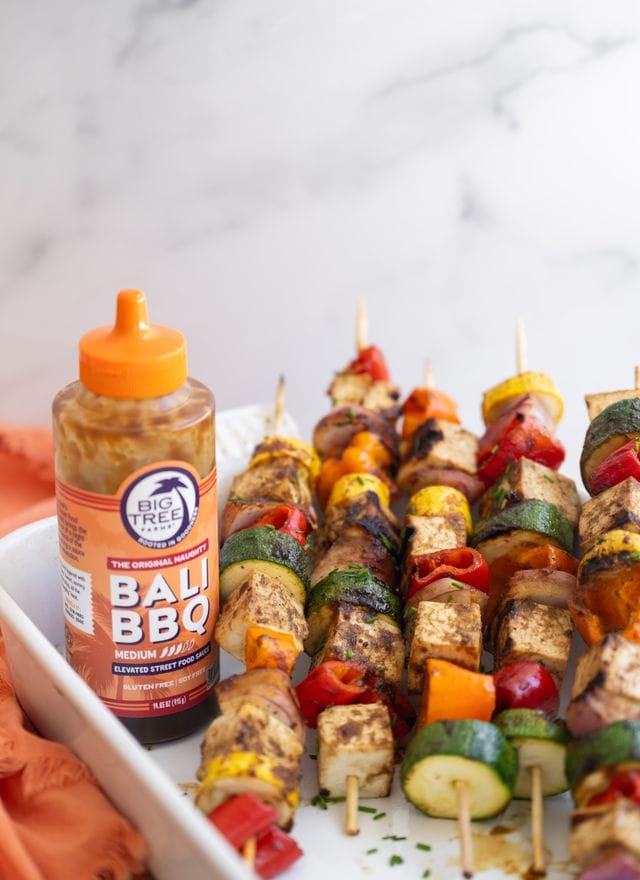 Inspired by a beloved restaurant in Bali, Bali BBQ is an easy way to elevate recipes with unique Indonesian flavors. | VegNews
Bringing Indonesian flavors to everyday cooking
As anyone who has ever traveled, been on vacation, or simply knows someone with an affinity for backpacking might understand, it can actually be pretty hard to translate an awe-inspiring experience from the other side of the world to people back home. Anecdotes about the people you met or the incredible sights you witnessed can sometimes fall flat when they become words hanging in the air over a cup of coffee on home soil.
But Ripple found another way to share Indonesia: through flavor. One of Big Tree Farms’ award-winning products, Naughty Bali BBQ Sauce, was inspired by years of visits to Naughty Nuri’s Warung, an iconic restaurant in Ubud famous for its unforgettable barbecue. The sauce isn’t a direct copy of the original, but rather an homage to the bold, layered flavors of Indonesian cuisine.
“It is this sort of alchemy of, or orchestration of, all of the various ingredients that make Indonesian foods so unique,” he explains. “It’s the shallot, it’s the garlic, it’s the ginger, it’s the tamarind, it’s the lemongrass, it’s the turmeric, and it’s the chilies. It’s not what most barbecue sauces are in the States.”
“The flavor of Indonesian cuisine is unlike any of the other Southeast Asian flavors,” says Ripple. “And that’s really cool. But it is the most underrepresented flavor in global cuisine, or Southeast Asian cuisine.”
The sauces are built on Coconut Aminos and whole-food ingredients, with no soy, gluten, refined sugar, artificial flavors, preservatives, or stabilizers. Perfect for modern consumers seeking out recognizable ingredients and rethinking heavily processed pantry staples. Plus, they’re versatile. “You can marinate in it. You can use it as a dipping sauce, you can use it on a grill, just baste it onto things, it’s not gonna burn,” he says. “It’s sort of idiot proof. It’s really good.”
The jewel in Big Tree Farms’ crown, though, has to be one of its OGs: the Coconut Aminos. Made slightly differently from coconut sugar, the aminos is created by melting down nira with Balinese sea salt. It is slowly kettle-cooked and fermented to create an umami-rich, slightly sweet substance that can be used as a direct swap for soy sauce. If you don’t want sweet, though, you can go for the low-sodium version, which is more savory. Pair it with vegetables, tofu, or the Indonesian classic and one of Ripple’s personal favorites—the fermented soybean staple, tempeh.
“Our mission now that we’ve built this amazing supply chain, which took us 20 years plus, is to really begin to bring what we call Bali Delicious to the world,” said Ripple. “It’s not all about Bali, of course. There are so many flavors from some of the islands, but we use the word Bali as a surrogate for Nusantara, which is the full archipelago.”
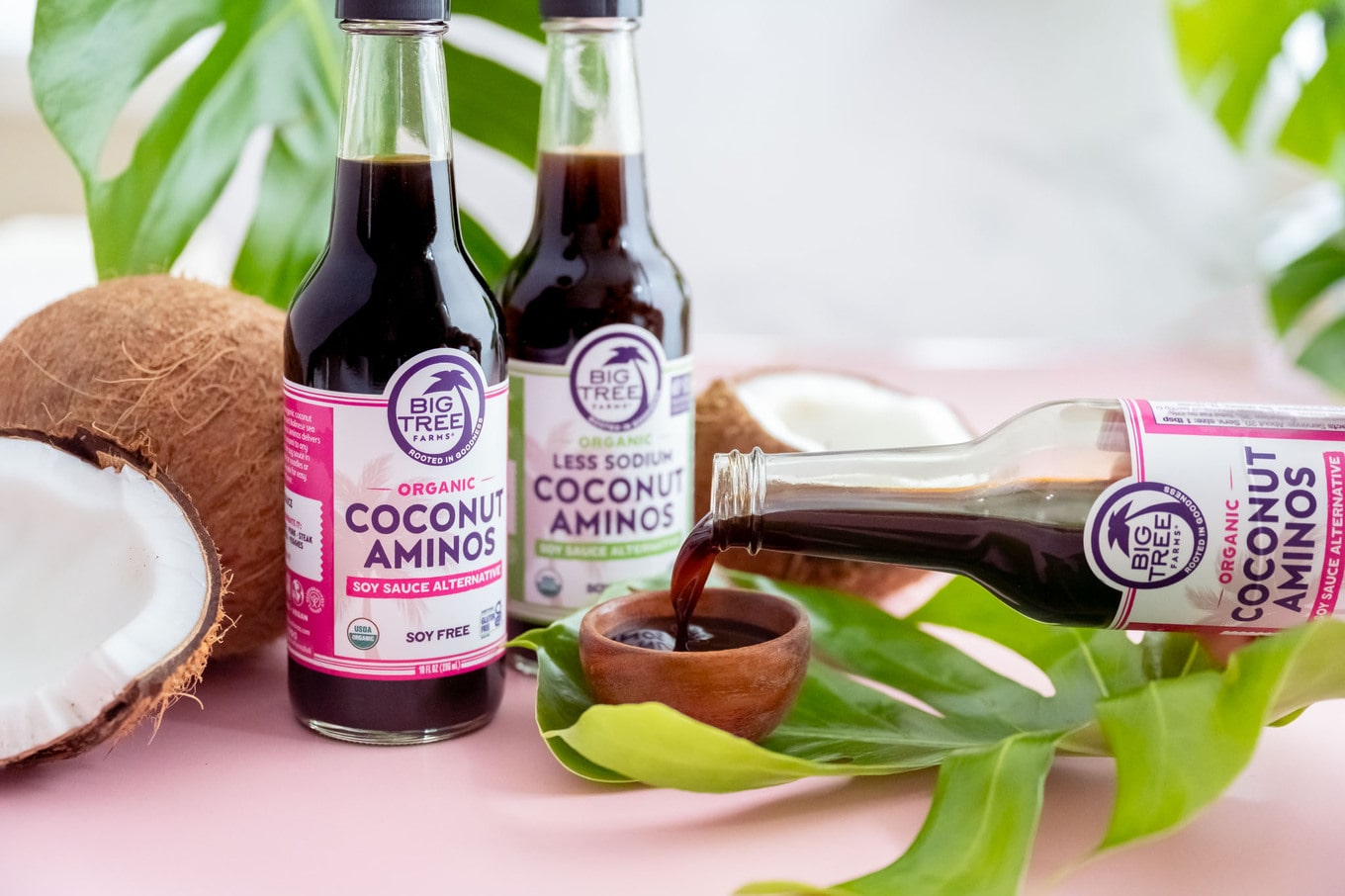 Big Tree Farms’ Coconut Aminos works as a direct swap for soy sauce. | VegNews
Regenerative food forests could shape the future of food
The future looks bright for Big Tree Farms, now based in Java, which plans to expand distribution and introduce even more people to the remarkable versatility of nira. But Ripple is determined that growth won’t come at the expense of the values that inspired the company in the first place. Supporting Indonesian farming communities remains central to the business, as does protecting the regenerative food forests where nira has been harvested for generations.
“The Indonesians have a different scale of agroforestry. It’s not agroforestry. It really, truly is permaculture,” says Ripple. “It is permanent agriculture. You cannot tell the difference. There’s no sign as you walk into these properties that this is a farm. This is a forest, and it’s a thriving forest.”
“We want to make this product a challenger to sugarcane, which is not sustainable or regenerative.”
Much of global agriculture relies on monoculture—vast swathes of land are dedicated to growing a single crop. While efficient, that approach can reduce biodiversity and place increasing pressure on soils over time. Indonesia’s food forests offer a different model, where multiple crops flourish together, supporting both ecological resilience and farming families whose livelihoods don’t depend on a single harvest.
Ripple believes more brands should look to Indonesia as an example. “There is such an immense amount of wisdom and opportunity in these systems for the rest of the world,” he says. But for him, it always comes back to our generous friend the coconut tree, which can produce more sugar than sugarcane with just a fraction of the land.
“Have you heard of coconut palms being called the ‘tree of life’?” asks Ripple. “It’s all over Southeast Asia. Different cultures have different words for it, but they all sort of translate into a tree of life. The coconut tree is revered so much because of how you can use it.”
He adds: “We need to tell the story of the magic of the ingredient behind coconut sugar and coconut aminos.”
Thank you to Big Tree Farms for partnering with VegNews on this story.
For more plant-based stories like this, read:
JUMP TO ... Latest News | Recipes | Guides | Health | Subscribe

Charlotte is a VegNews editor and writer based in sunny Southsea on England's southern coast.