


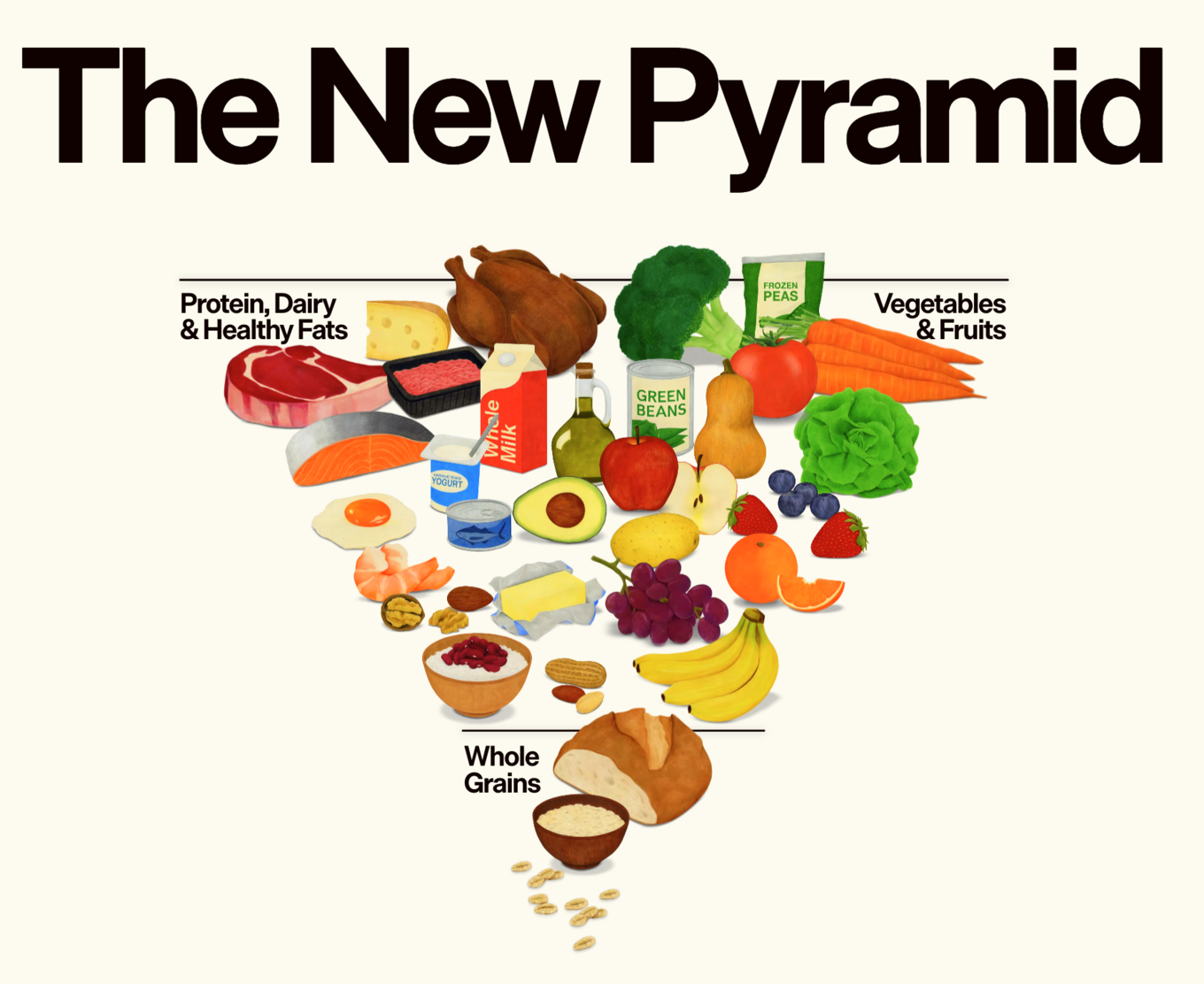
Unveiled this week as part of the updated Dietary Guidelines for Americans, the new US Food Pyramid graphic places protein and animal-based foods at the top of the pyramid, visually prioritizing them over fruits, vegetables, and whole grains. The change accompanies a broader push from the administration to encourage “whole foods” and reduce consumption of highly processed products and excess sugar. But it does that in a marked move away from decades of guidance that once discouraged saturated fat, primarily found in animal products—a move in line with the Make America Healthy Again movement.
Health and Human Services Secretary Robert F. Kennedy Jr. framed the shift as long overdue. “Protein and healthy fats are essential and were wrongly discouraged in prior dietary guidelines. We are ending the war on saturated fats,” he said at the announcement.
 realfood.gov
“In this new guidance, we are telling young people, kids, schools—you don’t need to tiptoe around fat and dairy. You don’t need to push low-fat milk to kids, and we are maintaining the 10 percent of calories as saturated fat in the guidance,” added Food and Drug Administration Commissioner Marty Makary. “The real issue is protein. The fact that 60 to 70 percent of the calories of kids today in America is ultra-processed food—these are the issues that have become giant blind spots where we’re not putting attention.”
But nutrition researchers and food policy experts question what happens when protein is elevated by default, and plant-based staples that most Americans already fall short on slide further down the hierarchy.
What the pyramid now de-emphasizes
For years, federal dietary guidance positioned fruits, vegetables, and whole grains as the foundation of daily eating, mirroring popular diets such as the Mediterranean Diet, consistently ranked the top diet by U.S. News & World Report. Protein sources appeared alongside fresh fruits and vegetables, but the new pyramid reverses that visual logic by pushing them to the side and dropping whole grains to the bottom.
“I’m very disappointed in the new pyramid that features red meat and saturated fat sources at the very top, as if that’s something to prioritize. It does go against decades and decades of evidence and research,” Christopher Gardner, a nutrition scientist at Stanford University and former member of the Dietary Guidelines Advisory Committee, told NPR.
Gardner and others emphasize that the issue is not refined carbohydrates versus protein, but the blurring of that distinction in public messaging. Whole grains, which include foods like oats, brown rice, and whole wheat, are consistently linked to lower risk of cardiovascular disease, improved gut health, and better long-term metabolic outcomes. Yet they are often swept into broad calls to “cut carbs,” despite offering nutrients that most Americans under consume, including fiber.
Fiber intake remains one of the most persistent gaps in US diets. According to federal data, fewer than one in 10 Americans meet recommended fiber intake levels. When grains and plant-based staples are visually deprioritized, experts worry that gap may widen.
Protein is not the limiting nutrient
The new pyramid arrives in a country already saturated with protein messaging.
Federal nutrition data show that protein accounts for roughly 16 percent of daily calorie intake among US adults, well within recommended ranges. The baseline recommended intake of 0.8 grams of protein per kilogram of body weight per day is intended to prevent deficiency, and most Americans meet or exceed it without effort.
 Getty
Getty
Still, protein has become the nutrient consumers are most eager to increase. Surveys show that more than 70 percent of Americans say they want to eat more protein, outpacing interest in fruits, vegetables, or fiber. Grocery shelves reflect that demand, with protein-forward claims appearing on everything from snack bars to beverages.
Nutrition researchers say this enthusiasm is largely cultural, not physiological. Protein is essential for muscle maintenance, immune function, and metabolism. But excess protein does not accumulate as reserve nutrition. According to guidance from the Mayo Clinic Health System, surplus protein is either burned for energy or stored as fat when calorie needs are already met. Meanwhile, diets that emphasize protein without balance often displace fiber-rich foods that support cardiovascular and digestive health.
Recent research has also complicated the assumption that more protein is always beneficial. A February 2024 study from the University of Missouri found that chronic overconsumption of protein can activate biological pathways associated with cardiovascular stress. Long-term observational studies have similarly linked very high protein intake, particularly from animal sources, to increased cardiovascular risk in older adults.
The new dietary guidelines retain the long-standing recommendation to limit saturated fat to 10 percent of daily calories. That guidance sits uneasily alongside a pyramid that visually elevates foods traditionally associated with saturated fat, creating what some experts see as mixed signals for consumers.
Why visual guidance still shapes diets
Although most Americans never read the Dietary Guidelines for Americans, the document does hold influence over daily food environments. Critically, it shapes school meal standards, military dining programs, and federal nutrition assistance packages, determining what institutions buy and serve at scale.
That is why visual tools like food pyramids matter. They are designed to simplify complex science into something intuitive. But simplification can also flatten nuance, especially in a food system shaped by access, affordability, and marketing.
 Canva
Canva
The updated guidelines do include widely supported recommendations, including calls to reduce added sugar and limit consumption of highly processed foods. Dariush Mozaffarian, MD, DrPH, MPH, a cardiologist and director of the Food Is Medicine Institute at Tufts University, has praised that emphasis. “Highly processed foods are clearly harmful for a range of diseases, so to have the US government recommend that a wide class of foods be eaten less because of their processing is a big deal and I think a very positive move for public health,” he said.
At the same time, Mozaffarian and others have stressed that dietary patterns matter more than single nutrients. Protein quality, plant diversity, and overall balance remain stronger predictors of long-term health than macronutrient hierarchy alone.
BECOME A VEGNEWS VIP: Get exclusive product deals, freebies, and perks galore!
As the new pyramid circulates, the concern among nutrition experts is not that Americans will suddenly eat too much protein; it is that the foods most people already struggle to eat enough of—whole grains, fruits, vegetables, and legumes—may feel optional rather than foundational.
“There’s good stuff in this and some not-so-good stuff,” Marion Nestle, PhD, MPH, a professor emerita of nutrition, food studies and public health at New York University, told MS Now. Nestle called the new guidelines “muddled, contradictory, ideological, and retro.”
“The prioritization of protein makes no sense,” Nestle says. “Most Americans already eat plenty.”
For more plant-based stories like this, read:
JUMP TO ... Latest News | Recipes | Guides | Health | Subscribe